
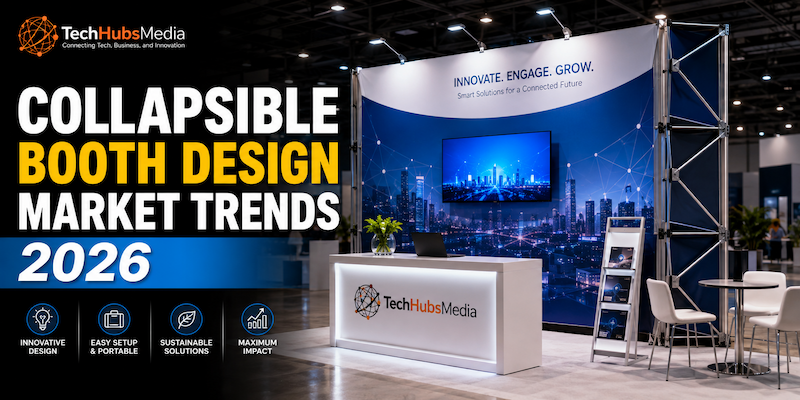
Trade shows are busy again, but the way brands build their spaces is changing fast. Heavy, one-use exhibits are losing ground. Companies now want booths that travel well, set up quickly, look polished, and work across many event sizes. That shift sits at the heart of collapsible booth design market trends 2026.
A collapsible booth is more than a pop-up wall. Modern systems can include folding frames, tension fabric graphics, modular counters, lightboxes, storage, digital screens, and tool-free connectors. A small team can pack many of these parts into wheeled cases and rebuild them at the next show.
Quick Answer
The biggest collapsible booth design market trends 2026 are reusable modular frames, lighter materials, faster tool-free setup, strong sustainability goals, integrated screens, smart lead capture, flexible layouts, and better storage. Buyers are also asking for clear lifetime cost data instead of looking only at the first purchase price.
Key Takeaways
- Reusable systems are moving from a budget choice to a core brand asset.
- Market research points to solid growth in modular exhibition stands through 2034.
- Sustainability now affects materials, shipping, graphics, lighting, and booth reuse plans.
- Digital tools work best when they support a simple visitor journey.
- The best booth is easy to carry, quick to build, safe to use, and simple to refresh.
- Buyers should compare total cost per event, not just the purchase price.
What Is a Collapsible Booth?
Definition
A collapsible booth is a portable exhibition system that folds, telescopes, or breaks into reusable parts for transport and storage. It can be rebuilt at trade shows, retail events, conferences, and brand activations.
The term covers several product types. Pop-up displays use expanding frames. Modular booths use repeatable beams and connectors. Tension fabric systems stretch printed graphics over light frames. Folding panel kits create walls, rooms, or product zones. Some systems combine all four ideas.
The main goal is simple: make a branded space easier to move and reuse. A good system should still feel stable and professional. Visitors should not see it as a temporary compromise. They should see a clear, inviting brand environment.
Collapsible does not mean small. Many suppliers now build systems for 10-by-10-foot spaces, larger inline stands, corner booths, and island exhibits. The same parts may form a compact booth at one event and a wider layout at another.
Market Size and Growth Trends for 2026
There is no single public data set for collapsible booths alone. Market reports often place them inside the broader modular exhibition stand or exhibition display market. This means exact totals vary by research method, product scope, and region.
One published market estimate valued the global modular exhibition stand market at about $1.54 billion in 2025 and projected it to reach about $2.84 billion by 2034, with a compound annual growth rate near 9.2%. The report links growth to demand for flexible, sustainable, and cost-efficient exhibit systems. Readers can review the summary from Research and Markets via GlobeNewswire.
The larger exhibition economy also supports demand. A 2026 industry estimate placed the global exhibition market at $51.2 billion in 2026, up from an estimated $46.3 billion in 2025. This figure covers much more than booth hardware, but it shows the scale of event activity around the products. Market totals should be treated as directional because commercial reports do not always use the same definitions.
Industry recovery is not even in every region. The Center for Exhibition Industry Research reported that its U.S. exhibition index for the second quarter of 2025 remained 8.4% below the same quarter in 2019. At the same time, current global outlook reports from UFI track stronger activity and changing expectations across many markets. The key point for booth buyers is not that every show is growing. It is that exhibitors face a mixed market and need assets that can adapt.
What Is Driving Growth?
- More repeat exhibiting: Brands want one kit that works at several shows.
- Higher freight and labor pressure: Lighter, tool-free systems can reduce handling needs.
- Sustainability targets: Reusable frames and replaceable graphics can cut material waste.
- Faster campaign cycles: Teams need to update messages without rebuilding the whole booth.
- Smaller event teams: Simple systems help fewer staff members manage setup.
- Growth in regional events: Portable booths are easier to move between smaller shows.
For 2026, growth is likely to favor systems that balance portability with a custom look. Plain pop-up walls still serve basic needs, but buyers increasingly expect better lighting, cleaner cable control, stronger storage, and modular add-ons.
7 Collapsible Booth Design Market Trends 2026
1. Reusable Modular Architecture Becomes the Default
The first major trend is a move away from fixed, single-layout displays. Brands want frames that can change shape. A back wall may become a corner unit. Two towers may split into smaller stations. A storage room may be removed when floor space is tight.
This shift changes how buyers judge quality. They now ask how many layouts one kit can support. They also ask whether new parts will connect with old parts. A strong system should grow with the event plan instead of becoming useless after one campaign.
Modular reuse also helps brand teams protect consistency. The same colors, shapes, lights, and counters can appear at events in different cities. Graphics can change while the core structure stays familiar.
2. Lighter and Stronger Materials Gain Share
Aluminum remains common because it is light, durable, and easy to machine. Tension fabric is popular because it packs into a small space and can create a smooth visual surface. Buyers also see more recycled panels, honeycomb boards, engineered wood, and lower-impact graphic materials.
The design goal is not only lower weight. Parts must also survive repeat use. Hinges, locks, feet, and connection points matter more than a glossy finish. A weak connector can end the useful life of the whole system.
In 2026, smart buyers will ask suppliers for part-level warranties and replacement options. They will also check whether common wear items can be changed without sending the full booth back to a factory.
3. Tool-Free Setup Moves From Feature to Standard
Fast setup is one of the clearest market demands. Exhibitors want labeled parts, magnetic locks, snap-fit frames, folding counters, and pre-wired light modules. The ideal booth can be assembled with few tools and a short guide.
Tool-free does not mean training-free. Staff still need a safe process. They should know which part goes first, how to lock each joint, where cables run, and how much weight shelves can hold.
Suppliers are responding with color-coded parts, QR-linked setup videos, and numbered packing plans. These details reduce mistakes and make it easier for local teams to build the same booth in different places.
4. Sustainability Needs Proof, Not Vague Claims
Sustainability is now tied to booth planning, vendor selection, and event reporting. Reuse is the strongest starting point. A frame used for many events can spread its production impact across a longer life.
Materials also matter. Buyers are asking about recycled content, repair options, local production, packaging, and end-of-life recycling. Energy-efficient LED lighting is common. Fabric graphics may reduce shipping volume, but their material and print process still need review.
A 2026 Salone del Mobile example shows how far this idea can go. Designer Giacomo Moor created a lightweight modular booth structure with standardized wood parts and aluminum connectors. The structure was designed for dismantling and a second use after the fair. The project also responded to a reported event waste figure of 13.12 kilograms per square meter.
Best Practice
Ask every supplier for a simple material and reuse plan. It should list frame materials, graphic materials, expected service life, repair options, packaging, and end-of-life choices.
5. Digital Tools Become More Purposeful
Large screens still attract attention, but screens alone do not create engagement. In 2026, better booths use digital tools for a clear task. A screen may explain one product. A tablet may help visitors compare plans. A QR code may open a product sheet. A sensor may count visits.
Lead capture is also becoming simpler. Many teams use dynamic QR codes because the destination can change after printing. A booth manager can send visitors to a landing page during the show and a follow-up offer later. TechHubsMedia’s guide to the top dynamic QR code generators for businesses explains tools that can support this use case.
The best digital setup keeps the visitor moving. It should not create a line, hide staff behind screens, or require a long form. A short scan, tap, or demo often works better than a complex game.
6. Flexible Zones Support Different Visitor Goals
One open space no longer fits every booth plan. Brands need zones for quick talks, product demos, private meetings, content capture, and storage. A collapsible system can define these zones without heavy walls.
For example, a 20-by-20-foot booth may include a bright welcome edge, a central demo counter, two soft seating areas, and a hidden supply cabinet. The next week, the same parts may form two 10-by-10-foot booths.
Good zoning also helps staff. They can guide a visitor from a fast introduction to a deeper talk. Clear paths reduce crowding and make the booth feel larger.
7. Total Cost per Event Replaces Sticker Price
A cheap booth can become expensive after freight, drayage, labor, repairs, storage, and replacement graphics. A higher-quality collapsible system may cost more at first but less over many uses.
Buyers are starting to compare total cost per event. The formula can include purchase cost, design, graphics, shipping, handling, labor, storage, maintenance, and expected number of uses.
For example, a $20,000 reusable booth used at 20 events has a base equipment cost of $1,000 per event before other costs. A $7,000 booth replaced after four events has a base cost of $1,750 per event. The cheaper first price is not always the lower long-term cost.
Collapsible vs. Custom vs. Rental Booths
| Factor | Collapsible Booth | Traditional Custom Booth | Rental Booth |
|---|---|---|---|
| Best for | Repeat exhibitors with changing layouts | Major launches and premium brand statements | One-time or test events |
| Setup | Often fast and tool-free | Usually needs skilled labor | Handled by rental partner in many cases |
| Transport | Compact cases or crates | Larger crates and higher freight needs | May ship locally from provider |
| Customization | Medium to high with graphics and modules | Very high | Low to medium |
| Reuse | High | Medium, depending on design | No ownership reuse |
| Upfront cost | Medium | High | Low to medium per event |
| Storage | Lower space need | Higher space need | Usually not the exhibitor’s issue |
| Main risk | Can look generic if poorly designed | High cost and low flexibility | Limited control and repeat cost |
No booth type wins every time. A collapsible system is often best for a company that attends several shows and needs a steady brand look. A custom build makes sense for a major event where the structure itself is part of the story. A rental can be wise when a company is testing a market or attending one distant show.
Benefits of Collapsible Booth Design
Lower Long-Term Cost
Reusable parts spread the purchase cost across many events. Replaceable graphics let the brand update a message without buying a full new booth.
Faster Setup and Breakdown
Folding frames and simple locks can reduce build time. That can lower labor needs and help teams leave the venue faster after a show.
Easier Shipping and Storage
Compact cases use less warehouse space. Lower weight may also reduce freight costs, although venue handling rules can still add fees.
More Layout Choices
A modular kit can fit different floor plans. This helps a brand attend both small regional shows and larger national events.
Better Brand Consistency
Teams can reuse core shapes, lights, counters, and graphics. The booth stays recognizable even when its size changes.
Less Material Waste
Reuse can reduce the need for one-time walls and signs. Repairable parts can extend service life and support a more circular event plan.
Main Challenges
A Generic Look
Many booths use the same frame shapes. Without strong graphics, lighting, and space planning, a display can look like a standard kit.
Wear From Repeat Use
Frames, hinges, zippers, and graphic edges can wear out. Poor packing makes damage more likely. A repair plan is essential.
Hidden Venue Costs
A lightweight booth does not remove every event charge. Venues may still bill for drayage, electrical service, internet, rigging, carpet, cleaning, and labor.
Limited Structural Freedom
Some dramatic shapes need custom fabrication. A collapsible kit may not support heavy overhead features or complex curves.
Screen and Cable Problems
Digital devices add weight, power needs, heat, and cable clutter. A booth should have safe mounts and clean cable paths.
Storage and Inventory Control
Small parts are easy to lose. A missing connector can delay setup. Teams need packing lists, labeled cases, and spare parts.
Best Practices for a High-Performing Booth
- Start with one goal. Decide whether the booth should create leads, book meetings, launch a product, or build awareness.
- Design the visitor path. Show where people enter, what they see first, and where staff start a conversation.
- Use one clear message. A visitor should understand the offer in a few seconds.
- Keep text large. Use short headlines that can be read from the aisle.
- Plan storage early. Hide cases, coats, drinks, and spare brochures.
- Light faces and products. Bright screens cannot replace good booth lighting.
- Test every layout. Build the booth before shipping it to the first event.
- Create a packing map. Show where each part belongs in each case.
- Carry spare parts. Include connectors, fasteners, tape, cables, and basic cleaning items.
- Measure results. Track scans, talks, demos, meetings, and qualified leads.
How to Plan a Collapsible Booth in Six Steps
- List event sizes. Write down every common footprint, such as 10-by-10, 10-by-20, and 20-by-20 feet.
- Set a full budget. Include design, hardware, graphics, cases, shipping, labor, storage, and repairs.
- Choose required zones. Pick areas for greeting, demos, meetings, and supplies.
- Review system options. Compare frames, connectors, graphics, counters, shelves, lights, and screen mounts.
- Build a sample layout. Test stability, sight lines, setup time, and visitor flow.
- Create an event playbook. Add setup instructions, staff roles, lead capture steps, and packing checks.
Buying Considerations
Booth Size and Layout Range
Do not buy only for the next show. List the footprints you expect to use over three years. Ask the supplier to draw each layout with the same core kit.
Packed Size and Weight
Check case dimensions and total weight. Find out whether cases can travel by parcel service, airline, freight carrier, or local van. A system is not truly portable if it needs difficult handling.
Setup Time and Crew Size
Ask for a timed setup test. Count every task, including lights, graphics, screens, shelves, and cable covers. A bare frame setup time is not enough.
Graphic Replacement Cost
Find the price and lead time for new graphics. Check whether panels can be changed one at a time. This makes campaign updates easier.
Hardware Quality
Inspect hinges, locks, feet, shelves, and screen mounts. Ask how each part is tested and what happens when a part fails.
Safety and Venue Rules
Confirm fire ratings for fabrics and panels. Review height limits, exit paths, electrical rules, and accessibility needs. Local event rules can change the final layout.
Lighting and Power
LED lights reduce energy use, but the booth still needs enough power outlets and safe cable paths. Build a power map before the event.
Warranty and Spare Parts
A long warranty is useful only when replacement parts are available. Ask whether the supplier stocks parts locally and how fast it can ship them.
Storage and Service
Some vendors offer storage, inspection, repair, and pre-show packing. These services can help teams that attend many events.
Total Cost per Event
Estimate the full cost over the expected service life. Divide that total by the number of planned events. Compare this figure across systems, rentals, and custom builds.
Expert Tips
Design for the Aisle, Not the Boardroom
A booth looks different from 20 feet away. Test headline size, contrast, and product visibility from the aisle. Remove details that cannot be read quickly.
Make the First Five Seconds Simple
Visitors should know who you help and what you offer. Use one headline, one strong image, and one clear action.
Keep the Front Edge Open
Large counters at the aisle can form a barrier. Move heavy furniture inward and give people an easy way to enter.
Use Screens at Eye Level
A screen placed too low draws attention away from staff. A screen placed too high can be hard to view. Test the height before the show.
Plan for Real Staff Behavior
Staff need places for bags, chargers, water, and notes. Without storage, these items will appear in visitor areas.
Build a Graphic Refresh Cycle
Do not replace every panel at once. Keep long-life brand panels and update campaign panels as needed. This saves money and reduces waste.
Track Booth-Level Data
Measure more than badge scans. Track which demo drew interest, which message led to meetings, and which layout kept visitors longer.
Create a Repair Kit
Pack spare connectors, approved tape, fabric cleaner, power adapters, and printed setup instructions. A small kit can prevent a large show-day problem.
Future Outlook
The future of collapsible booths will likely be more modular, measurable, and circular. Buyers will expect systems to last longer and adapt faster. Suppliers will compete on ease of use, not only appearance.
Digital parts may become easier to swap. Screen mounts, sensors, lights, and power modules could use standard connection points. This would let brands update technology without replacing the frame.
Material records may also improve. Buyers may receive clearer data on recycled content, repairability, and end-of-life options. Some companies may track how many events each part has served.
Local production and service networks could gain value. A global brand may own one design system but source graphics, repair, and support near each event. This can reduce shipping distance and speed up fixes.
Artificial intelligence may help with planning rather than dominate the booth itself. Teams could use software to test layouts, predict visitor flow, create graphic versions, or score leads. Yet human staff will remain central. Trade shows work because people meet people.
By 2028 and beyond, the best collapsible systems may feel less like portable displays and more like product platforms. A common frame will support different walls, lights, counters, storage units, and digital tools. The exhibitor will choose the parts needed for each goal.
Frequently Asked Questions
What is a collapsible trade show booth?
It is a portable exhibit system that folds or breaks into reusable parts for easier shipping, storage, setup, and use at multiple events.
Are collapsible booths suitable for large exhibits?
Yes. Modular systems can support larger inline, corner, and island layouts when the frame, engineering, and venue rules match the planned design.
How long does a collapsible booth last?
Service life varies by material, use, packing, and care. Quality frames can serve many events when worn graphics and small parts are replaced.
Do collapsible booths look cheap?
Not when they use strong graphics, clean lighting, hidden storage, good spacing, and quality hardware. Poor design, not portability, causes a cheap look.
How much does a collapsible booth cost?
Prices vary widely by size, materials, graphics, lighting, storage, and technology. Compare full lifetime cost and expected uses, not only purchase price.
Can a small team set one up?
Many systems are made for small crews, but the team still needs training, safe lifting methods, clear instructions, and enough time for testing.
What materials are common in 2026?
Common choices include aluminum frames, tension fabric, recycled panels, engineered boards, LED lightboxes, and replaceable printed graphic skins.
How can a booth be more sustainable?
Reuse the frame, repair parts, replace only needed graphics, choose lower-impact materials, reduce shipping volume, use LEDs, and plan end-of-life recovery.
Should a company buy or rent a booth?
Buy when you exhibit often and need consistency. Rent when testing a market, attending one distant show, or avoiding storage and ownership duties.
What technology belongs in a collapsible booth?
Use technology that supports one goal, such as a product demo, meeting booking, lead capture, or content delivery. Avoid screens with no clear purpose.
Conclusion
The strongest collapsible booth design market trends 2026 point in one direction: brands want adaptable spaces that cost less to move, waste less material, and work harder at every event. Reusable frames, fast setup, lighter materials, flexible zones, and focused digital tools are shaping purchase decisions.
A collapsible booth is not automatically the best choice. It must fit the event plan, brand style, crew size, safety rules, and total budget. Buyers should test the system, inspect the hardware, plan storage, and compare cost per event.
The winning design will not be the one with the most parts or screens. It will be the booth that helps visitors understand the offer, enter the space, meet the team, and take the next step. That is the practical value behind collapsible booth design market trends 2026.
