7 Proven Nashville SMP Marketing Growth Tactics
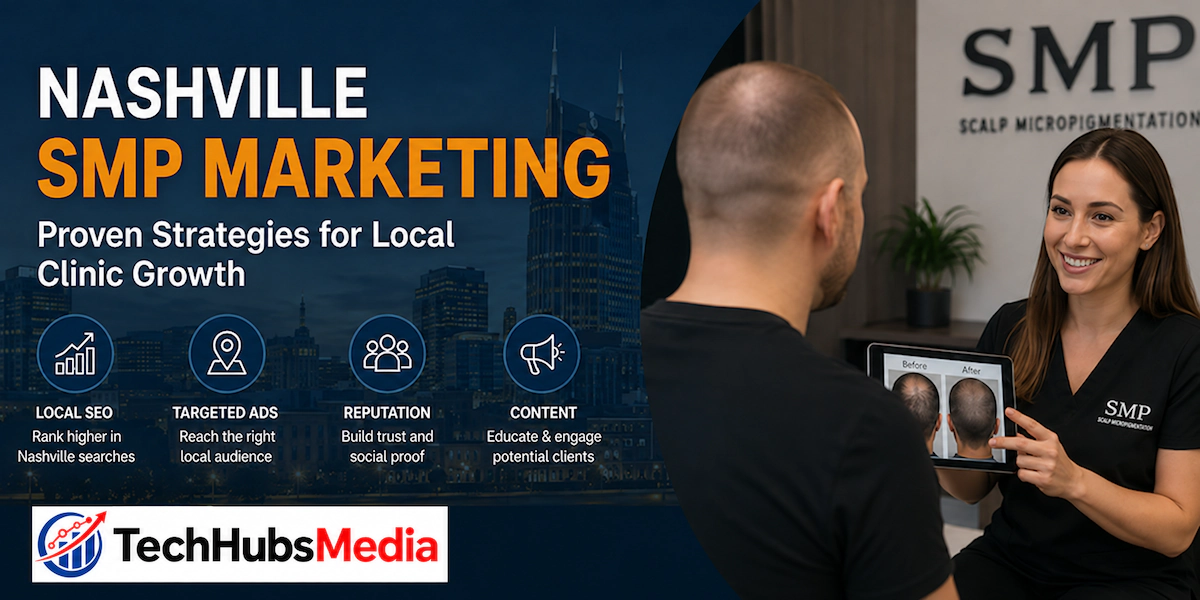
Quick answer: Nashville SMP marketing is local marketing for scalp micropigmentation clinics in the Nashville area. It works when proof comes before persuasion: verified before-and-after photos, recent Google reviews, honest pricing, and a consultation booking that takes under a minute. The treatment costs thousands of dollars and takes several sessions, so trust does the selling.
Nashville SMP marketing fails for a predictable reason. Clinics market a premium medical-adjacent service the way a salon markets a haircut, with discounts and volume. Someone deciding whether to put permanent pigment into their scalp is not looking for a deal. They are looking for evidence that you will not ruin their hairline.
Turning clinic traffic into booked consultations is the job of our conversion rate optimization services.
Key takeaways
- SMP typically costs $1,800 to $4,500 in total, at roughly $400 to $1,000 per session across two to four sessions.
- The global scalp micropigmentation services market was valued near $3.4 billion in 2026 and is projected to grow steadily through the next decade.
- Around 44% of local search clicks go to the three businesses in the map pack, so the Google Business Profile is the main storefront.
- Almost all consumers read reviews before choosing a local provider, which makes review recency a growth channel rather than an afterthought.
- Testimonials and before-and-after photos are regulated advertising claims in the US, so disclosure and accuracy are not optional.
What is Nashville SMP marketing?
Nashville SMP marketing is the set of activities that gets a scalp micropigmentation clinic found and booked by people in Davidson County and the surrounding areas. In practice it covers the Google Business Profile, local search pages, before-and-after galleries, review generation, social proof, and a consultation process built for people who are nervous.
The product shapes the marketing. SMP is a high-ticket, multi-session, visually permanent decision. Nobody books it impulsively at midnight, and nobody books it from a page that hides the price.
Why local trust beats broad reach
A Nashville clinic does not need a national audience. It needs a few hundred people within driving distance who are actively researching hair loss options this quarter. That audience behaves in a specific way: they search privately, compare three or four clinics, study photos closely, read the one-star reviews first, and often take weeks before contacting anyone.
So the job is not awareness. It is removing doubt, repeatedly, across every surface they will check before they call.
Pricing transparency converts better than pricing secrecy
Published cost guides put scalp micropigmentation at roughly $1,800 to $4,500 in total, with individual sessions around $400 to $1,000 and most clients needing two to four sessions spaced four to six weeks apart. Touch-ups commonly run $350 to $1,000.
Prospects already know these numbers before they reach you. A clinic page that refuses to indicate pricing does not create curiosity, it creates suspicion, and the visitor leaves for a competitor who published a range. Show a range, explain what changes it, and say what a consultation covers.
Seven tactics that actually book consultations
- Treat the Business Profile as your homepage. Correct primary category, complete service list, real hours, and new photos every month.
- Build one page per intent. Hairline restoration, density work, scar camouflage, alopecia coverage, and women's SMP each deserve a page, not a bullet point.
- Photograph properly. Same lighting, same angles, same distance, immediately before and after, plus a healed photo weeks later. Inconsistent photos read as edited.
- Systematise reviews. Ask at the final session, in person, with a QR code that opens the review form.
- Answer the fear questions publicly. Does it hurt, does it fade, what if I hate it, what does it look like at 60. Those pages rank and they convert.
- Make consultations low commitment. Free, short, no pressure, with a clear description of exactly what happens.
- Use local sponsorship, not discounts. A barbershop partnership brings better prospects than a price cut, and it does not devalue the service.
Which channels earn their place
| Channel | What it does | Realistic timeline | Effort |
|---|---|---|---|
| Google Business Profile and reviews | Captures people already searching in Nashville | Weeks | Low, but continuous |
| Local service pages | Wins non-branded searches and answers objections | Two to four months | Medium, one-off with updates |
| Before-and-after galleries | Converts the people who already found you | Immediate | Ongoing, per client |
| Instagram and TikTok | Demonstrates skill visually, builds recognition | Three to six months | High |
| Barbershop and clinic referrals | Warm prospects who already trust the referrer | Weeks | Medium, relationship-led |
| Paid search | Immediate visibility for high-intent terms | Days | Budget dependent, competitive |
Most clinics overinvest in social and underinvest in the profile and the gallery. Social builds recognition. The profile and the photos close.
A 90-day Nashville SMP marketing plan
| Period | Focus | Outcome to expect |
|---|---|---|
| Weeks 1 to 2 | Profile audit, category fix, photo shoot, review system set up | Profile views and calls begin rising |
| Weeks 3 to 6 | Service pages written, pricing range published, schema added | Pages indexed, first non-branded impressions |
| Weeks 7 to 10 | Gallery rebuilt, objection pages published, referral partners approached | Consultation rate per visitor improves |
| Weeks 11 to 13 | Review flow steady, tracking verified, first ranking movement reviewed | A clear picture of cost per booked consultation |
The legal part most clinics get wrong
Before-and-after photos and testimonials are advertising claims in the United States. They must reflect typical results, be genuine, and disclose any material connection, including free treatment given in exchange for a review or a post. The Federal Trade Commission publishes clear guidance on reviews and testimonials, and it is worth ten minutes of a clinic owner's time.
Three rules keep a clinic out of trouble: never incentivise a positive review specifically, never publish a retouched result photo, and never imply a permanent outcome that requires touch-ups without saying so.
Measuring what matters
- Cost per booked consultation, not cost per click or per lead.
- Consultation to treatment rate. If consultations are plentiful and bookings are not, the problem is the consultation, not the marketing.
- Profile actions. Calls, direction requests and website clicks from Google.
- Review velocity. New reviews per month, and their average age.
- Revenue per new client, including touch-ups, which is the number that justifies your acquisition spend.
Track the source of every enquiry by asking the caller. In a business with this few monthly transactions, analytics alone will mislead you.
A real example from our own work
The most useful thing we have learned about this market came from building GetMoreReview, our review management product. Local service businesses collect dramatically more reviews when three conditions hold: the request comes from a person rather than an automated email, it happens at the moment of visible result, and the action takes one tap.
For an SMP clinic that means the final session, not a follow-up email three days later. Hand the client a mirror, let them look, then hand them a card with a QR code that opens the review page. That single change usually moves review rate more than any advertising budget, and reviews feed both local rankings and the AI answers that increasingly summarise local options. The tooling side is covered in our guide to dynamic QR code generators for businesses, which explains how to keep one printed code pointing wherever you need it.
Common mistakes to avoid
- Hiding prices completely, which filters out serious buyers rather than tyre kickers.
- Galleries of other artists' work, which clients detect faster than you expect.
- Discount offers on a permanent cosmetic procedure.
- Booking forms that ask for fifteen fields before a first conversation.
- Ignoring negative reviews instead of answering them calmly.
- Service-area settings that hide the clinic from searches in its own neighbourhood.
The technical basics worth getting right
Add LocalBusiness structured data with your address, hours, price range and service area. Google's documentation on LocalBusiness structured data covers the required properties. Compress gallery images so the page loads quickly on mobile, since most of this traffic arrives on a phone. Then read Google's own advice on improving local ranking, which is short, official and free.
The same local fundamentals apply in any market, and we set out a UK version of this playbook in our Basingstoke SEO guide if you want to see how the structure transfers.
Frequently asked questions
What is SMP marketing?
Marketing for scalp micropigmentation clinics, focused on local search visibility, verified before-and-after proof, reviews and a consultation process that converts cautious prospects.
How much does scalp micropigmentation cost in Nashville?
Published guides put total cost between roughly $1,800 and $4,500, with sessions near $400 to $1,000 and most clients needing two to four sessions.
How do SMP clinics get more clients?
By ranking in the local map pack, publishing honest pricing, showing consistent before-and-after photos, collecting recent reviews, and making consultations easy to book.
Should an SMP clinic publish prices?
Yes, at least a range. Prospects research pricing before contacting anyone, and a page with no numbers loses them to a competitor that shows figures.
Which platform works best for SMP clinics?
Google Business Profile drives the most booked consultations. Instagram and TikTok build recognition and demonstrate skill, but they rarely close on their own.
Are before-and-after photos allowed in advertising?
Yes, when they are genuine, unretouched and representative of typical results. Material connections behind testimonials must be disclosed under FTC guidance.
How many reviews does a clinic need?
Enough to match the clinics ranking above you, then a steady monthly flow. Recency and detailed text matter as much as the total number.
How long before marketing produces bookings?
Profile and review work can lift enquiries within weeks. Ranking for non-branded local searches usually takes three to six months of consistent effort.
Is paid advertising worth it for SMP?
It can be, given the high job value, but only once the profile, gallery and pricing page are strong. Paid traffic exposes weak pages faster.
What is the biggest marketing mistake SMP clinics make?
Competing on price. The decision is driven by trust in the artist's hand, so proof and consistency beat discounts in every case we have seen.
Conclusion
Nashville SMP marketing comes down to making a nervous buyer comfortable. Publish a price range, show your own work photographed consistently, ask every satisfied client for a review at the moment they see the result, and keep the Google Business Profile accurate. Those four habits outperform any campaign, and they compound quietly month after month.