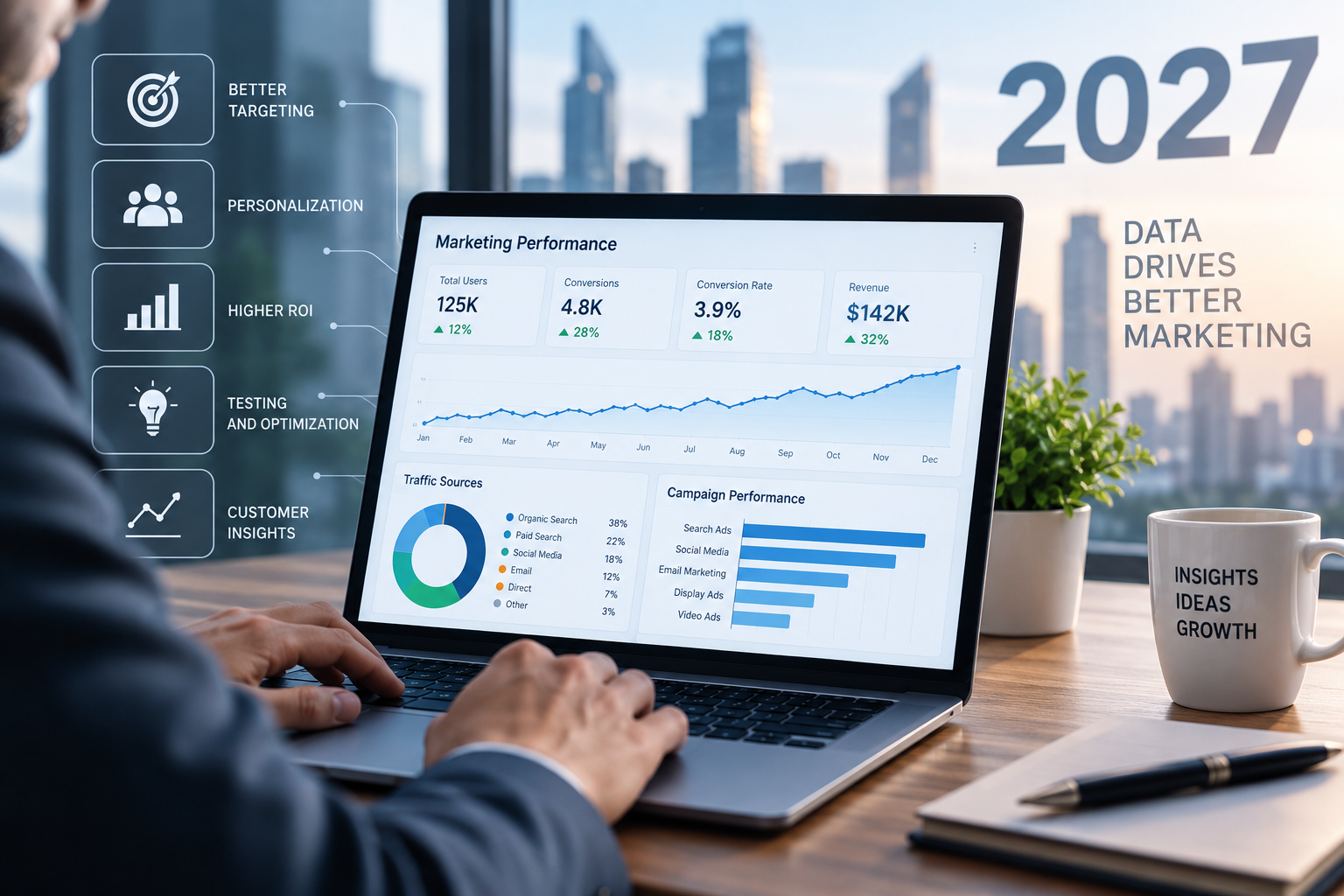
Marketing in 2027 will not simply be about creating advertisements and hoping that people respond. Businesses will have access to more information about their customers, their interests, and the way they interact with different brands. The real challenge will be understanding that information and using it in a meaningful way.
This is where data and analytics can make a real difference. When used properly, data can help marketers understand what their audience wants, identify which campaigns are performing well, and discover where money and effort may be going to waste. Instead of relying entirely on assumptions, businesses can study real customer behavior and make more informed decisions.
Understanding What Customers Actually Want
One of the biggest advantages of using data is that it gives businesses a clearer understanding of their customers.
People generate useful information whenever they interact with a business online. They visit websites, search for products, click on advertisements, read articles, watch videos, and engage with social media posts. All of these actions can help marketers understand what attracts a customer’s attention.
For example, if visitors regularly read articles about a particular topic, it may show that they have a strong interest in that subject. If a product page receives plenty of visits but very few purchases, there may be something preventing customers from completing their purchase.
These insights can help businesses make improvements based on real customer behavior rather than guesswork.
Making Marketing More Personal
Most people have little patience for marketing that feels irrelevant to them. Seeing the same generic message repeatedly can quickly become frustrating.
In 2027, personalization will become even more important. Data can help businesses create marketing campaigns that are more relevant to different groups of customers.
Someone who has already purchased a product may need a different message from someone visiting a website for the first time. Similarly, a customer interested in one type of product may not be interested in advertisements for something completely different.
By understanding these differences, marketers can create content and campaigns that feel more useful and less random.
The goal is not simply to gather customer insights. The real purpose is to use those insights to provide a better and more relevant experience.
Finding Out Which Campaigns Are Working
Marketing campaigns can run across many different platforms. A business might use search engines, social media, email, websites, videos, and other channels at the same time.
Without proper analytics, it can be difficult to know which efforts are producing the best results.
Data allows marketers to examine campaign performance more closely. They can see how many people visited a website, how long they stayed, what actions they took, and whether those actions led to sales or other important results.
For example, one campaign may bring a large number of visitors but very few customers. Another campaign may attract fewer people but generate more sales.
Looking only at traffic numbers could create the wrong impression. Analytics helps marketers understand the bigger picture and focus on the results that matter most.
This same approach is important in organic marketing. A strong B2B SaaS SEO strategy should look beyond rankings and traffic to qualified visits, conversions, sign-ups, pipeline contribution, and revenue attribution.
Spending Marketing Budgets More Wisely
Every business wants to get better results from its marketing budget. However, money can easily be wasted when businesses continue investing in campaigns that are not performing well.
Data makes it easier to identify these problems.
Marketers can compare different campaigns and determine where their budget is producing the strongest results. If one platform consistently performs better than another, it may deserve more attention and investment.
At the same time, poor-performing campaigns can be improved, adjusted, or stopped altogether.
This does not mean that every marketing decision should be based on numbers alone. Creativity and experience still matter. However, having accurate information makes it easier to make smarter and more confident decisions.
Testing Different Ideas
Even experienced marketers cannot always predict how people will react to a campaign.
A headline that seems perfect may fail to attract much attention. On the other hand, a simple advertisement may perform surprisingly well. This is why testing is so important.
Analytics allows marketers to compare different versions of their campaigns.
They can test headlines, images, email messages, landing pages, and calls to action. By studying the results, they can discover what works best for their audience.
Small improvements can sometimes make a significant difference.
Over time, regular testing helps businesses learn more about their customers and improve the quality of future campaigns.
Understanding the Customer Journey
Customers do not always make a decision immediately.
Someone may first discover a business through a social media post. A few days later, they might visit the company’s website. Later, they may read a blog article or receive an email before finally deciding to make a purchase.
Not every customer leaves an obvious engagement signal along the way. Social media silent scrollers may view content, save it, search for the brand later, or make a purchase without ever liking or commenting, which is why marketers should connect social metrics with website and conversion data.
Data and analytics can help marketers understand this entire journey.
Knowing how customers move from one stage to another can help businesses create better experiences. It also allows marketers to understand which activities play an important role in the final decision.
This information will be especially valuable in 2027, when customers will interact with brands across more platforms and devices than ever before.
Using Data to Prepare for Future Trends
Another important benefit of analytics is the ability to identify patterns.
By studying customer behavior over time, businesses may notice changes in interests, buying habits, or market demand. Search data can provide another useful source of these signals. For example, a programmatic SEO strategy can use structured datasets and repeatable search patterns to identify demand, create targeted pages, and monitor which opportunities actually generate impressions and traffic. These patterns can help marketers prepare for possible changes before they become obvious.
For example, if interest in a particular product category continues to grow, a business may decide to create more content or campaigns around that area.
This does not mean that data can perfectly predict the future. Markets and customer behavior can change quickly. However, reliable information can help businesses make better predictions and prepare for new opportunities.
The Human Side of Data-Driven Marketing
Although technology and analytics will play a bigger role in marketing, the human side of marketing will still matter.
Data can tell a business what people are doing, but it cannot always explain why they feel a certain way. Numbers can show that customers stopped engaging with a campaign, but human understanding is needed to create a better message.
The best marketing campaigns in 2027 will likely combine both approaches.
Marketers will use data to understand campaign performance and customer behavior, while creativity will help them develop messages that people can genuinely connect with.
Conclusion
Data and analytics will continue to change the way businesses plan and improve their marketing campaigns in 2027. They can help companies understand customers, personalize communication, measure campaign performance, manage spending, and identify new opportunities.
However, data alone is not the answer to successful marketing.
The real value comes from understanding the information and using it wisely. Businesses that combine useful data with creativity, experience, and a genuine understanding of their audience will be in a stronger position to create marketing campaigns that deliver meaningful and long-lasting results.
