Programmatic SEO: Complete Guide, Tools, Examples and Strategy

·

·

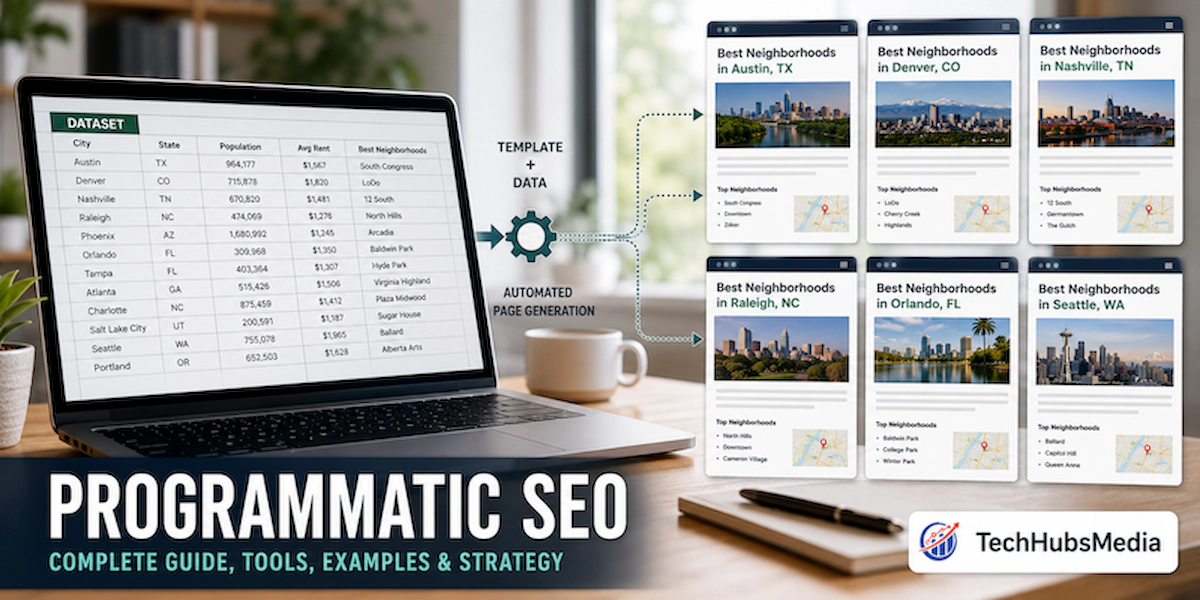
Programmatic SEO workflow showing a data table generating multiple ranking web pages

Quick Answer: Programmatic SEO is a method for creating hundreds or thousands of search-optimized pages from one template and one dataset. You pick a repeatable keyword pattern, gather structured data, build a page template, and generate pages at scale. It works best when real search demand exists for every page you publish and each page gives the reader something useful.

Key Takeaways

  • Programmatic SEO builds many pages from a single template plus a structured dataset.
  • It only works when each generated page answers a real search query with real value.
  • The biggest wins come from long-tail keywords with clear patterns, such as “X vs Y” or “best X in Y city.”
  • Google penalizes thin, mass-produced pages, so quality control matters more than volume.
  • Costs range from almost nothing to several thousand dollars per month, depending on tools and data sources.
  • AI speeds up content generation, but it does not replace data quality or human review.

Table of Contents

  1. What Is Programmatic SEO?
  2. How Programmatic SEO Works
  3. Programmatic SEO vs Traditional SEO
  4. Examples of Programmatic SEO
  5. Programmatic SEO Strategy: 9 Steps
  6. Best Programmatic SEO Tools
  7. How AI Supports Programmatic SEO
  8. Programmatic SEO for SaaS
  9. Programmatic SEO for Ecommerce
  10. APIs and Automated Publishing
  11. Common Mistakes
  12. Best Practices for 2026
  13. Costs and Pricing
  14. Case Study
  15. Benefits and Challenges
  16. Market Size and Trends for 2026
  17. Buying Considerations
  18. Future Outlook
  19. Expert Tips
  20. Frequently Asked Questions
  21. Conclusion

What Is Programmatic SEO?

Programmatic SEO is the practice of building large sets of web pages automatically. You do it with a page template and a structured data source, such as a spreadsheet or a database.

Here is the simple version of the programmatic SEO definition. You find a keyword pattern that repeats. Then you fill that pattern with data. Each combination becomes its own page.

Think about a phrase like “flights from [city A] to [city B].” There are thousands of city pairs. Writing each page by hand would take years. A template plus a flight database can produce them all in a day.

That is the programmatic SEO meaning in plain terms. One template, many pages, all driven by data.

This method is not new. Travel sites, job boards, and real estate portals have used it for over a decade. What changed is that the tools got cheaper and easier. A small team can now do what once needed engineers.

But scale alone is not the goal. A page that exists only to catch a keyword will not last. Search engines have gotten much better at spotting empty pages. The pages that win are the ones that solve a small, specific problem for the reader.

A Clear Definition

Programmatic SEO: A content production method that generates many search-optimized landing pages from a shared template and a structured dataset, targeting predictable long-tail keyword patterns at scale.

How Programmatic SEO Works

So how does programmatic SEO work in practice? The process has five moving parts.

1. The keyword pattern. This is a phrase with one or more variables. Examples include “[software] alternatives,” “best [product] for [use case],” or “[job title] salary in [city].”

2. The dataset. This is the raw material. It might be a list of cities, a product catalog, an API feed, or a spreadsheet you built by hand. Every row becomes one page.

3. The template. This is the page design. It has fixed parts that never change and dynamic parts that pull from your dataset. Headings, intro text, tables, and FAQs can all be templated.

4. The generation layer. This is the code or tool that merges the data with the template. It could be a static site generator, a WordPress plugin, or a no-code tool.

5. The publishing layer. This pushes finished pages live, handles URLs, and updates your sitemap.

Once the system runs, adding new pages is as simple as adding new rows to your dataset.

The tricky part is not the technology. It is deciding which rows deserve a page. If a keyword gets ten searches a year, that page will probably never earn a click. Filtering your dataset before you publish saves you from a bloated, low-quality site.

Programmatic SEO vs Traditional SEO

Both approaches want the same thing: rankings and traffic. They just get there in different ways.

FactorProgrammatic SEOTraditional SEO
Page volumeHundreds to millionsDozens to hundreds
Content creationTemplate plus dataWritten individually
Keyword typeLong-tail, low volume, high countHead terms and mid-tail
Time to launchSlow setup, fast scalingSteady pace throughout
Cost per pageVery low once builtModerate to high
Main riskThin or duplicate contentSlow growth
Best forDatabases, directories, comparisonsThought leadership, brand topics
Human inputFront-loaded into design and QASpread across every article
Update methodRefresh the datasetRewrite each page

The two work well together. Traditional content builds topical authority and earns links. Programmatic pages capture the long tail underneath that authority.

Most successful sites use both. A specialist B2B SaaS SEO agency will often pair a small set of deep guides with a large programmatic layer for comparison and integration pages.

Examples of Programmatic SEO

Real programmatic SEO examples make the idea click faster than any explanation.

  • Zapier integration pages. Zapier has a page for nearly every app pair it connects. “Connect Gmail to Slack” is one page. “Connect Gmail to Trello” is another. The dataset is their integration library. The template is the same each time. This alone drives a huge share of their organic traffic.
  • Zillow property and area pages. Zillow generates pages for cities, neighborhoods, ZIP codes, and individual homes. The data comes from listings and public records. Each page answers a real question: what is happening in this market?
  • TripAdvisor location pages. “Things to do in [city]” exists for thousands of cities. The content is built from reviews, photos, and listings that users contribute.
  • Indeed salary pages. “[Job title] salary in [city]” pulls from millions of posted jobs. The data updates itself as new listings arrive.
  • G2 comparison pages. “[Tool A] vs [Tool B]” pages are generated from their review database and product profiles.
  • Wise currency pages. “Convert [currency A] to [currency B]” uses live exchange rate data. The page is genuinely useful because the number changes daily.

Notice the pattern in all six. Each page contains information the reader cannot easily get elsewhere. The data is the value, not the words around it.

Programmatic SEO Strategy: 9 Steps

Here is how to do programmatic SEO without wasting months on pages that never rank.

Step 1: Find a Repeatable Keyword Pattern

Look for phrases people search in the same shape over and over. Start with your own product features, your customer questions, and your competitors’ URL structures.

Good patterns usually contain a variable that has many valid values. Cities, job titles, product categories, and competitor names all work well.

Step 2: Validate Real Search Demand

Pull search volume for a sample of your pattern. Take twenty or thirty combinations and check them.

If most have zero volume, the pattern is too narrow. If a handful have volume and the rest are empty, filter aggressively before you build.

A useful rule: only publish a page if you can name the person searching for it and what they want next.

Step 3: Build Your Dataset

This is where most projects live or die. Your data can come from your own product database, a public API, government open data, licensed data, or manual research.

Clean it carefully. Fix missing values. Standardize formats. Remove duplicates. A messy dataset produces messy pages.

Step 4: Design the Page Template

Sketch what a reader needs on this page. Then build backwards.

Every good template has three layers. Dynamic data that changes per page. Contextual content that changes based on data values. Static content that stays the same, such as your methodology or trust signals.

Aim for at least fifty percent unique content per page. If two pages differ by only a city name, you have a problem.

Step 5: Plan Your URL Structure

Keep URLs short, readable, and consistent. Use a clear folder for the page type, then the variable.

Something like /compare/tool-a-vs-tool-b/ reads better than /p?id=48213.

Step 6: Handle Internal Linking

Orphan pages do not get crawled. Build hub pages that link to your programmatic pages by category, letter, or region.

Also link between related generated pages. A city page should link to nearby cities. A comparison page should link to other comparisons involving the same tool.

Step 7: Generate and Review a Pilot Batch

Publish fifty pages first, not five thousand. Watch them for four to eight weeks.

Check indexing rates, impressions, average position, and bounce behavior. If the pilot fails, fix the template before you scale.

Step 8: Scale in Controlled Waves

Release pages in batches. This keeps crawl demand reasonable and makes problems easier to trace.

Submit sitemaps per batch so you can see which group indexes well.

Step 9: Prune and Refresh

After ninety days, review performance. Pages with no impressions after several months are candidates for removal, noindexing, or consolidation.

Refresh your dataset on a schedule. Stale data is the fastest way to lose a page that once ranked.

Best Programmatic SEO Tools

The best programmatic SEO tools depend on your stack and your team’s technical comfort. Here are the main categories.

  • Keyword research and validation: Ahrefs, Semrush, and Keyword Insights help you size a pattern before you build it. Google Search Console shows what you already rank for.
  • Data collection: Apify, Bright Data, and Octoparse handle scraping where it is permitted. Public APIs and open data portals are often better and safer sources.
  • Data storage: Airtable, Google Sheets, Supabase, and Postgres all work. Sheets is fine under a few thousand rows. Beyond that, use a real database.
  • Page generation: Webflow CMS, Next.js with static generation, Astro, and Hugo are common. On WordPress, plugins such as WP All Import and custom post types with ACF can do the job.
  • No-code assembly: Whalesync, Make, and Zapier connect your data source to your CMS without engineering time.
  • Content generation: Byword, SEO.ai, and Jasper generate templated copy. Custom scripts calling an LLM API give you more control.
  • Monitoring: Search Console, Screaming Frog, and Sitebulb catch indexing gaps, duplicate titles, and broken templates.

Pick tools that match your volume. A thousand pages does not need enterprise infrastructure. A million pages does.

How AI Supports Programmatic SEO

Programmatic SEO with AI has become the default approach for most teams in 2026. AI helps in four specific places.

  • Filling content gaps. Your dataset might have a name, a price, and a category, but no description. An AI model can write a short, factual summary from those fields.
  • Creating content variation. Templates produce repetitive phrasing. AI can rewrite intros and transitions so pages read differently while keeping facts identical.
  • Summarizing structured data. Given a table of specifications, AI can write a paragraph explaining what those numbers mean for the reader.
  • Quality checks at scale. You can run generated pages through a model that flags missing data, awkward phrasing, or factual contradictions.

There is a real limit here. AI does not create data. If your dataset is thin, AI output will be padding, and readers will feel it.

Brand consistency also matters at scale. Teams working on AI normalization and transformation rules often find that standardizing how entities are named and described across thousands of pages is harder than generating the pages themselves.

Use AI for the layer around your data. Never use it to invent the data itself.

Programmatic SEO for SaaS

Programmatic SEO for SaaS works because software buyers search in very predictable shapes.

The highest value patterns include:

  • Alternatives pages: “[Competitor] alternatives”
  • Comparison pages: “[You] vs [Competitor]”
  • Integration pages: “[Your product] + [Other tool] integration”
  • Use case pages: “[Your product] for [industry or role]”
  • Template and resource pages: “[Document type] template”
  • Free tool pages: calculators, generators, and checkers

Integration pages deserve special attention. They rank well, they convert well, and they scale naturally as your integration library grows.

Comparison pages need care. Be accurate and fair about competitors. Outdated or unfair comparisons damage trust and invite complaints.

For SaaS teams, the conversion path matters as much as the ranking. Each page should offer one clear next step, such as a free trial, a demo, or a relevant guide.

Many SaaS teams start with programmatic pages before they have topical authority. That usually fails. Build a foundation of strong editorial content first, then layer the programmatic pages on top. Working with an experienced SEO agency can help you sequence those two efforts correctly.

Programmatic SEO for Ecommerce

Programmatic SEO for ecommerce is often the difference between a store that ranks and one that does not.

Common page types include:

  • Category and subcategory pages: “[Product type] for [use case]”
  • Attribute pages: “[Color] [product type]” or “[Size] [product type]”
  • Brand and category crossovers: “[Brand] [product type]”
  • Comparison pages: “[Product A] vs [Product B]”
  • Buying guide pages: “Best [product type] under [price]”
  • Location pages: where you serve specific regions

The main risk in ecommerce is faceted navigation. Filters can generate millions of URL combinations, most of which have no search demand.

Control this carefully. Allow indexing only for filter combinations that people actually search for. Block or canonicalize the rest.

Product availability creates another challenge. When items sell out, the page can become useless. Plan for what happens to a page when its data disappears. Redirecting to a parent category usually beats a dead page.

Local intent adds another layer. Stores serving specific regions can generate location pages, though the same rules that govern local SEO in smaller markets still apply. Each location page needs genuine local information, not just a swapped town name.

APIs and Automated Publishing

A programmatic SEO API setup removes manual work from the publishing step.

Here is a typical pipeline:

  1. A scheduled job pulls fresh data from a source API.
  2. A transformation script cleans and validates that data.
  3. A content function generates or updates the page body.
  4. The CMS API creates or updates the page.
  5. The sitemap regenerates and pings search engines.

On WordPress, the REST API handles posts, pages, custom post types, media, and taxonomies. You can also use WP-CLI for bulk operations on your own server.

Headless setups pair a CMS API with a static site generator. Pages rebuild when data changes, which keeps everything fast.

Two safeguards are essential in any automated pipeline.

Validation before publish. Never push a page with missing critical fields. A page reading “Best hotels in null” will get indexed if you let it.

A rollback plan. If a template bug affects five thousand pages, you need a way to fix or unpublish them quickly.

Log everything. When rankings drop, you will want to know exactly which batch changed and when.

Common Mistakes

Programmatic SEO common mistakes repeat across almost every failed project.

  • Publishing before validating demand. Building ten thousand pages for keywords nobody searches wastes crawl budget and dilutes your site.
  • Thin content. If your page has forty words of unique text and nothing else, it will not rank and may drag down neighboring pages.
  • Near-duplicate pages. Swapping one word between pages is not variation. Search engines cluster these and pick one, ignoring the rest.
  • Ignoring search intent. A keyword pattern might exist while the intent behind it varies wildly. “Best CRM for dentists” and “best CRM for enterprises” need different page structures.
  • Orphaned pages. Pages with no internal links rarely get crawled or ranked.
  • No pruning process. Sites accumulate dead pages for years. Regular cleanup keeps quality signals healthy.
  • Stale data. A pricing page showing last year’s numbers loses trust immediately.
  • Skipping the pilot. Launching at full scale before testing the template turns a small mistake into a site-wide one.
  • Poor page speed at scale. Templates that load heavy assets multiply that cost across every page.

Best Practices for 2026

These programmatic SEO best practices reflect how search has changed.

  • Lead with proprietary data. Pages built on data only you have are much harder to displace. Aggregated reviews, usage statistics, and original research all qualify.
  • Write for a specific reader. Before you build the template, describe the person landing on one page. What did they search? What do they need in ten seconds?
  • Build genuine content depth. Add contextual sections that change based on data values. A city with high prices needs different commentary than a cheap one.
  • Show your methodology. Explain where your data comes from and when it was last updated. This builds trust with readers and reviewers.
  • Keep templates fast. Optimize images, defer scripts, and cache aggressively. Speed problems compound across large page sets.
  • Use structured data. Schema markup helps search engines understand what your generated pages contain.
  • Set indexing rules deliberately. Decide upfront which pages get indexed. Noindex low-value combinations rather than hoping they get ignored.
  • Review a sample by hand. Read twenty random pages every month. You will catch problems no automated check finds.
  • Plan for query changes. Search behavior shifts. Review your keyword pattern annually to see if it still matches how people search.

Costs and Pricing

Programmatic SEO pricing varies widely. Here is what typically drives cost.

  • Keyword and SEO tooling. Mid-tier plans from major SEO platforms usually run from around one hundred to several hundred dollars per month, depending on seats and limits.
  • Data acquisition. This is the most variable line item. Public APIs and open data can be free. Licensed commercial datasets can cost thousands per month.
  • Content generation. LLM API costs for short generated sections are usually a fraction of a cent per page. Full-length AI articles cost more. Human editing is the expensive part.
  • Infrastructure and hosting. Static hosting for a few thousand pages is inexpensive. Large dynamic sites with heavy database queries cost significantly more.
  • Development. A custom pipeline built in-house takes engineering weeks. Agency builds are typically quoted as project fees.
  • Ongoing maintenance. Budget for data refreshes, template updates, and monitoring. This is a running cost, not a one-time build.

A small project using existing tools and a manual dataset can launch for very little. A large enterprise system with licensed data and custom infrastructure sits at the other end of the range.

Get quotes rather than relying on published figures. Pricing in this space changes often, and most serious data licensing is negotiated.

Case Study

Here is a representative programmatic SEO case study drawn from patterns common across B2B software companies.

  • The situation. A project management tool had strong brand traffic but almost no traffic from buyers comparing options. Their blog ranked for a handful of broad terms. Competitors dominated comparison searches.
  • The pattern chosen. The team targeted two patterns: “[Their product] vs [Competitor]” and “[Competitor] alternatives.” They identified roughly forty relevant competitors.
  • The dataset. They built a structured comparison table covering pricing tiers, core features, integrations, support options, and typical company size. Data came from public pricing pages, product documentation, and their own sales team’s competitive notes.
  • The template. Each page opened with a short summary of who each tool suits. Then came a full feature comparison table. Then sections on pricing, migration, and common objections. Each page closed with an honest statement of when the competitor is the better choice.
  • The rollout. They published fifteen pages first. After six weeks, twelve were indexed and four were generating impressions. They improved the template based on what those four had in common, then released the remaining pages in three batches.

What worked. The honest “when to choose them” section improved time on page noticeably. Sales reported that prospects mentioned the comparison pages during calls.

What did not work. Pages targeting very small competitors got no traffic and were later consolidated into a single roundup page.

The lesson. Fewer, better pages beat more, thinner pages. The forty-competitor list should have been twenty from the start.

Benefits and Challenges

Benefits

  • Scale. You capture long-tail demand that would be uneconomical to target one page at a time.
  • Efficiency. Cost per page drops sharply once the system is built.
  • Consistency. Every page follows the same quality standard and structure.
  • Easy updates. Changing the template updates every page at once.
  • Compounding returns. Adding data rows adds pages with little extra effort.
  • Competitive moat. Large, well-built page sets are hard for competitors to replicate quickly.

Challenges

Programmatic SEO challenges are real and worth understanding before you commit.

  • Quality risk. Mass production makes it easy to publish weak pages.
  • Policy risk. Google’s scaled content abuse policy specifically targets pages produced at scale primarily to manipulate rankings.
  • Data dependency. If your data source changes or disappears, your pages break.
  • Crawl budget limits. Large sites can struggle to get all pages crawled and indexed.
  • Maintenance burden. Thousands of pages need ongoing attention.
  • Technical complexity. Pipelines break in ways that are hard to spot without monitoring.
  • Slower initial results. The setup phase produces nothing for weeks or months.

Market Size and Trends for 2026

The broader SEO services market has continued to grow through the mid-2020s, with commonly cited industry estimates placing global spending in the tens of billions of dollars annually. Content automation is one of the faster-growing segments within it.

Several programmatic SEO trends 2026 are worth watching.

  • AI search results are reshaping click behavior. AI overviews and answer engines reduce clicks on purely informational queries. Pages built on unique, structured data hold up better because the data itself is the reason to visit.
  • Quality thresholds keep rising. Google’s guidance since 2024 has made clear that scaled production alone is not the issue. Scaled production without value is. Enforcement has tightened.
  • Entity-based optimization matters more. Search engines increasingly understand pages in terms of entities and relationships rather than keywords alone. Clean, consistent naming across thousands of pages helps.
  • No-code pipelines are mainstream. Teams without engineers now build programmatic systems using connected SaaS tools.
  • First-party data is the differentiator. As generic content becomes cheap, pages built on data you own become the durable advantage.
  • Hybrid models dominate. Most teams now combine templated structure with meaningful human input on high-value pages.

Buying Considerations

If you are evaluating tools, agencies, or platforms, here is what to weigh.

  • Data ownership. Do you own the dataset, or does the vendor? If you leave, what do you keep?
  • Template flexibility. Can you build genuinely different page structures, or only fill blanks in a fixed layout?
  • Export options. Can you export your pages and data in a usable format?
  • Scale limits. What happens at ten thousand pages? At a hundred thousand?
  • Update mechanics. How easy is it to refresh data and regenerate affected pages?
  • Quality controls. Does the tool prevent publishing pages with missing data?
  • CMS compatibility. Does it work with your existing stack, or does it require migration?
  • Support and documentation. Complex pipelines break. Response time matters.
  • Total cost over three years. Include data licensing, maintenance, and staff time, not just software fees.

Ask vendors for examples of live sites using their system. Then check those sites in Search Console-style tools to see whether the pages actually rank. Some technical SEO providers make strong indexing claims that deserve verification before you sign anything.

Future Outlook

The next few years will likely reward depth over volume.

Search engines are getting better at judging whether a page adds anything. Pages that repackage widely available information will keep losing ground. Pages built on data the reader cannot get elsewhere will keep their value.

Expect three shifts.

  • Data becomes the product. The template will matter less than what fills it. Companies with proprietary datasets will have a structural advantage.
  • Generation gets cheaper and less important. When anyone can produce a million pages, producing them stops being a competitive edge.
  • Curation returns. The skill will shift from making pages to deciding which pages deserve to exist.

Programmatic SEO is not going away. It is maturing. The teams that treat it as a data problem rather than a content problem will do best.

Expert Tips

  • Start with your own data. Look at what your product or business already knows that nobody else does. That is your best starting point.
  • Cap your first project at fifty pages. You will learn more from fifty pages you watch closely than five thousand you ignore.
  • Read your pages out loud. If a sentence sounds like a mail merge, rewrite the template.
  • Track indexing rate as your main early metric. Traffic comes later. Indexing tells you fast whether the pages are acceptable.
  • Add one human element per page. A short editorial note, a caveat, or a recommendation makes a templated page feel considered.
  • Keep a kill list. Decide upfront what performance level triggers removal, then act on it.
  • Version your templates. When rankings shift, you need to know which template version each page used.
  • Diversify your data sources. Depending on a single API is a business risk, not just a technical one.

Frequently Asked Questions

Is programmatic SEO against Google’s guidelines?

No, not by itself. Google’s scaled content abuse policy targets pages created at scale mainly to manipulate rankings without providing value. Generating pages from real data that genuinely helps users is acceptable. The distinction is value, not volume.

How many pages do I need for programmatic SEO to work?

There is no minimum. Some projects succeed with two hundred well-built pages. Others need tens of thousands. What matters is whether each page targets real demand and answers it well.

How long does programmatic SEO take to show results?

Expect three to six months for meaningful traffic. Setup takes several weeks. Indexing takes weeks more. Rankings improve gradually after that.

Do I need a developer for programmatic SEO?

Not always. No-code tools can connect a spreadsheet to a CMS without any code. Larger or more complex projects usually benefit from developer support, especially for data pipelines and performance.

Can programmatic SEO hurt my site?

Yes, if done badly. Publishing large numbers of thin or duplicate pages can reduce overall site quality signals. Pilot testing and pruning prevent most of this risk.

What is the difference between programmatic SEO and AI content?

Programmatic SEO is a structural approach using templates and data. AI content is one possible way to fill parts of that template. You can do programmatic SEO with no AI at all.

Which industries benefit most from programmatic SEO?

Travel, real estate, jobs, software, ecommerce, finance, and local services all have naturally repeating search patterns and rich datasets. Any business with structured data and predictable queries is a candidate.

How do I stop my programmatic pages from looking duplicated?

Increase the share of content that varies with your data. Add conditional sections that change based on values. Include unique data points, not just unique names.

Conclusion

Programmatic SEO gives you a way to capture search demand that would be impossible to reach one page at a time. It works by pairing a well-designed template with a dataset that carries real value.

The method itself is straightforward. Find a repeating keyword pattern. Validate demand. Build clean data. Design a template with genuine depth. Test small. Scale carefully. Prune regularly.

The hard part is discipline. It is tempting to publish everything your dataset allows. Resist that. Every page you publish should have a reader you can picture and a question you can answer.

Teams that treat programmatic SEO as a data quality exercise consistently outperform teams that treat it as a volume exercise. Start with fifty pages, learn what works, then grow from there.