B2B SaaS SEO Agency: How to Choose One in 2026
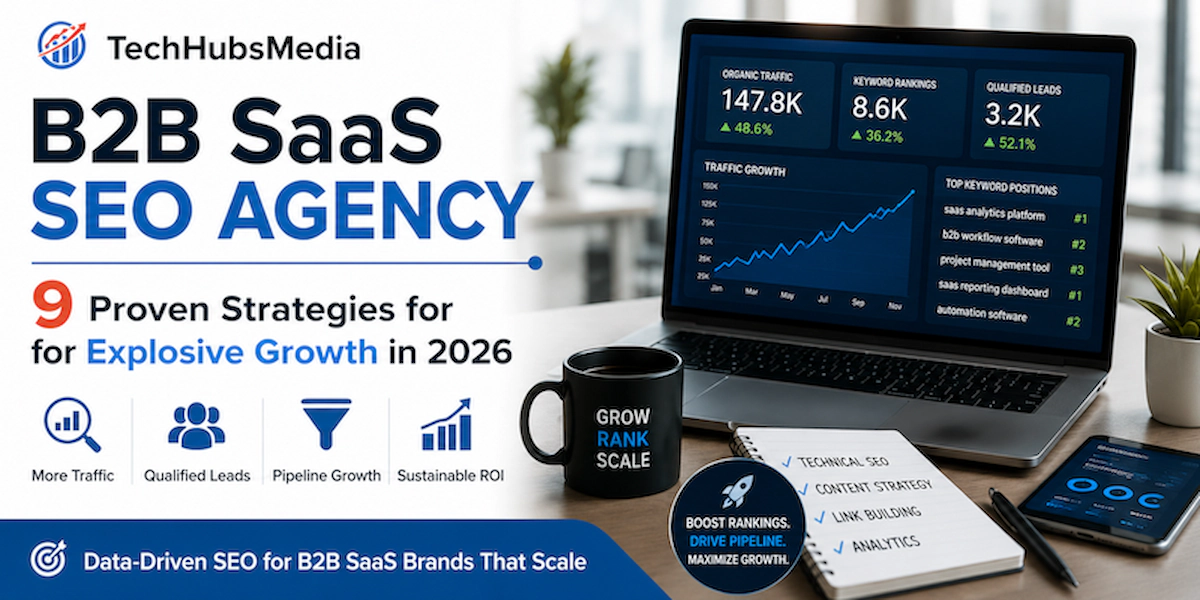
Quick answer: A B2B SaaS SEO agency plans and runs organic growth for software companies that sell to other businesses. The good ones tie technical health, product-led content, commercial pages and links to trials and demos. Retainers commonly run from about $2,000 to $20,000 a month in 2026, and the deciding factor is whether the agency can explain how a page becomes pipeline.
Hiring is hard because every B2B SaaS SEO agency sells the same ingredient list. Keywords, content, links, audits. The pitch decks look alike. The outcomes do not. This guide gives you a way to tell them apart before money changes hands, based on how we run SEO for our own software products and what we see when we audit sites that have already been through two or three agencies.
If you have already done the research and want to see how we run the work, our B2B SaaS SEO services page sets out the deliverables and the reporting.
Key takeaways
- A specialist agency plans page types around the SaaS buying journey, not around a blog calendar.
- Published 2026 pricing guides put SaaS SEO retainers between roughly $2,000 and $20,000 a month, with one-off audits and sprints from about $5,000.
- Ask for the reasoning behind one decision on a real site. Generic answers are the fastest disqualifier.
- A 90-day pilot with agreed milestones protects you far better than a twelve-month contract.
- Since AI Overviews began absorbing informational clicks, an agency that cannot talk about citations and entity signals is selling a 2021 service.
What is a B2B SaaS SEO agency?
A B2B SaaS SEO agency is a search marketing firm that works specifically with software companies selling subscriptions to businesses. The work covers technical SEO, keyword and intent research, content production, commercial page strategy, link acquisition, and reporting that connects organic sessions to sign-ups, demos and revenue.
The difference from a general SEO agency is not effort. It is page inventory. An ecommerce site has products and categories. A SaaS site has features, integrations, use cases, comparisons, alternatives, templates, documentation, a changelog, a pricing page and a knowledge base, and each of those serves a different moment in a buying cycle that can run for months across a buying committee.
Why SaaS search marketing works differently
Three things change the job.
The buyer researches alone. Most of the evaluation happens before anyone contacts sales. Your pages are the sales call. That means a comparison page has to admit where a rival is stronger, because the reader is checking that claim in another tab.
The product is the proof. A SaaS article that never shows the product solving the problem produces traffic and nothing else. Product-led content is not a slogan. It means the screenshot, the workflow and the limitation all appear in the guide.
Revenue is delayed. A trial started in March can become revenue in July. Agencies that report on traffic are usually agencies that never set up the tracking to report on anything else.
What belongs in a B2B SaaS SEO agency scope
A complete scope covers six areas. If a proposal misses one, ask who owns it.
| Area | What it includes | Who usually owns it |
|---|---|---|
| Technical | Crawling, indexation, canonicals, redirects, Core Web Vitals, schema | Agency writes tickets, your developers ship |
| Intent research | Keyword to page-type mapping across the funnel | Agency, validated by your sales team |
| Commercial pages | Comparisons, alternatives, integrations, use cases | Agency writes, product reviews |
| Editorial content | Guides, original data, expert commentary | Agency, with subject-matter interviews |
| Authority | Editorial links, digital PR, brand mentions, review sites | Agency |
| Measurement | GA4 events, Search Console, CRM handoff, AI citation tracking | Agency sets up, you own the accounts |
Two of those are quietly the most predictive. Whoever owns measurement controls the story told at the quarterly review, and that should be you. And commercial pages, not blog posts, are where SaaS pipeline usually starts.
What a B2B SaaS SEO agency costs in 2026
Pricing guides published this year put monthly retainers between roughly $2,000 and $20,000 or more, with project work such as audits and focused sprints somewhere between $5,000 and $25,000. Four models are common.
| Model | Typical range | Best for | Watch out for |
|---|---|---|---|
| Monthly retainer | $2,000 to $20,000+ | Ongoing programmes | Vague deliverables inside a fixed fee |
| Project or sprint | $5,000 to $25,000 | Audits, migrations, one-off fixes | No one owns implementation afterwards |
| Performance based | Share of pipeline or per lead | Mature funnels with clean attribution | Attribution disputes in AI-influenced journeys |
| Hybrid | Base plus bonus | Mid-market SaaS | Bonus definitions written loosely |
Cheap is not the risk. Unclear is. A $3,000 retainer with four defined deliverables beats an $8,000 retainer described as "ongoing optimisation".
Agency, consultant or in-house
All three work. They fail for different reasons.
- Agency. You get technical, content and link capability at once. The risk is being handed to a junior after the pitch, which is why you ask who does the work, by name, in writing.
- Consultant. Cheaper and often sharper strategically. They cannot also write twelve pages a month, so you still need writers. Our guide to working with a SaaS SEO consultant covers when that model fits.
- In-house. Best long-term ownership and product knowledge. Slowest to start, and one person rarely covers technical work, writing and outreach at a good standard.
Many SaaS teams end up with a hybrid: one in-house owner who holds the strategy, and an agency supplying execution capacity.
Ten questions that expose a weak provider
- Show me a page you wrote that ranks and converts. Why is it structured that way?
- Which of our page types would you build first, and which would you delay?
- How would you tell whether our trial page is losing people before or after the form?
- Who writes the content, and what is their SaaS background?
- How do you vet a link opportunity, and what makes you reject one?
- What does your reporting look like in month two, when rankings have barely moved?
- How do you measure whether we are cited in AI answers?
- What would make you tell us to stop paying you?
- Which client results can I verify with a screenshot from their Search Console?
- What happens to the work and the documentation if we leave?
Question eight matters more than it looks. An agency with a real methodology can describe the point where more spend stops helping. One without will say growth is always possible.
How to read agency rankings and reviews
Most "top B2B SaaS SEO agency" lists are published by agencies that place themselves at number one. That does not make them useless, but read them as marketing rather than research. Directory listings on Semrush, Clutch or G2 tell you a company exists, has clients and sits in a category. They do not tell you who will do your work.
Two checks are worth more than any list. Search the agency's own domain for the commercial terms it claims to win for clients. Then ask a current client, not a reference the agency chose, what changed in the first six months.
Red flags worth walking away from
- Guaranteed rankings, guaranteed positions, or guaranteed AI mentions. Nobody controls those.
- Link packages sold by volume, with no discussion of relevance or indexing.
- Reporting built on impressions and keyword counts with no conversion data.
- A twelve-month lock-in with no exit for non-performance.
- Deliverables that only appear after signature.
- Instant results promises. We looked at that pattern in detail in our piece on claims about instant SEO visibility.
Run a 90-day pilot before the retainer
A pilot gives you evidence instead of a pitch. Scope it tightly: a technical audit with tickets, two commercial pages written and shipped, tracking fixed, and a documented plan for the next quarter. Agree in advance what counts as success, because success at 90 days is rarely traffic. It is usually pages indexed and ranking in the top 20, tracking you trust, and a plan your team believes.
If the agency resists a pilot, that is information. The good ones use pilots too, because a bad client fit costs them more than it costs you.
What the first 90 days should look like
| Period | Work | Evidence you should see |
|---|---|---|
| Weeks 1 to 2 | Technical audit, baseline, competitor and SERP analysis | Prioritised issue list, current numbers written down |
| Week 3 | Intent map and page plan | Every keyword tied to one page type and funnel stage |
| Weeks 4 to 8 | Critical fixes shipped, first commercial pages live | Tickets closed, pages indexed, tracking firing |
| Weeks 9 to 12 | Content cadence, first links, measurement review | Rankings moving on long-tail terms, a written next quarter |
How to measure the work honestly
Pick four numbers before the engagement starts and keep them for a year. Organic sign-ups or demos. Assisted pipeline from organic. Rankings for your ten commercial terms. Indexed pages that receive clicks. Everything else is diagnostic detail.
Watch for one distortion in 2026: branded traffic. An agency that grows branded search while your non-branded terms stagnate is reporting your marketing team's work as its own. Split the two in every report.
A real example of the work
We build and grow our own software, which is where our method gets tested first. IMQRScan is a dynamic QR code platform in a category dominated by funded competitors bidding on every head term. Chasing "QR code generator" would have been expensive and slow, so we mapped intent instead and built use-case and comparison pages aimed at people who already knew what they needed. We fixed crawling and Core Web Vitals so those pages could rank, wrote guides that answer the buying question in the first two sentences, and kept product facts identical everywhere Google and AI systems read them.
IMQRScan content now appears in Google AI Overviews and AI-powered search results. The lesson that transfers to any SaaS: the pages that earn revenue are usually the ones nobody enjoys writing, and they need a clean technical base underneath them. Where a page inventory repeats in a predictable pattern, the same thinking scales through programmatic SEO.
What changed in 2026: the AI layer
Buyers now ask ChatGPT, Perplexity, Gemini or Google's AI Overview for a shortlist before they open a results page, and industry analyses through 2026 report meaningful click loss on informational queries where an AI answer appears. The uncomfortable part is that the answer often quotes pages that rank, so SEO still feeds it. The work is additive rather than replacement: direct answers near the top of the page, consistent facts about your company everywhere, structured data, and mentions on the review sites and comparison lists those systems draw from.
Google's own guide to optimizing for generative AI features is worth reading before you accept a proposal that treats AI search as a separate product with a separate invoice. Ask any agency how it measures citations today. If the answer is a vague promise, keep looking. Our view of the underlying market pressure is unchanged since Grand View Research's SaaS market report set out how fast the category keeps expanding: more competitors, more content, higher standards.
How to shortlist in one afternoon
Take five candidates. Send all of them the same three questions: what would you fix first on our site, what would you build in the first 90 days, and how will we know it worked. Score the replies on specificity alone. Ignore design, ignore awards, ignore client logos.
Two will send templates. Two will send a slightly better template. One will point at something specific on your site that you did not know was broken. That is your shortlist of one, and it is usually right. The same test works for evaluating any provider, including the international specialists we looked at in our review of how to evaluate an SEO agency, and for smaller local markets, as covered in our practical SEO growth tactics guide.
Frequently asked questions
What does a B2B SaaS SEO agency do?
It runs organic growth for a software company: technical fixes, keyword and intent mapping, product-led content, commercial pages, link acquisition, and reporting tied to trials and demos.
How much should we pay a SaaS SEO agency?
Published 2026 guides show retainers from roughly $2,000 to $20,000 a month. Pay for defined deliverables rather than hours, and prefer clarity over a lower headline price.
How long before SEO produces demos?
Technical fixes and commercial pages often move within 8 to 12 weeks. Content-led growth compounds across 6 to 12 months, so judge early progress on indexation and rankings.
Should we hire a specialist or a generalist agency?
A specialist understands SaaS page types and buying cycles, which saves months. A generalist can work if it has genuine software clients and proves it with real examples.
Can a small SaaS company afford an agency?
Yes, by scoping smaller. Start with a technical audit and three commercial pages rather than a full content programme you cannot sustain past the first quarter.
What contract length is reasonable?
Three to six months with a clear exit, or a 90-day pilot first. Twelve-month lock-ins protect the agency, not your budget or your results.
How do we check an agency's own SEO?
Search their commercial terms and see where they rank. An agency invisible for its own service keywords should explain why before asking you to trust its plan.
Do we still need SEO if AI answers questions?
Yes. AI systems mostly cite pages that already rank well, so ranking remains the foundation. Add structure, consistent entity facts and citations on top of it.
Who should own SEO reporting?
You should. Keep Search Console, GA4 and your CRM in your own accounts, and give the agency access rather than depending on their dashboard.
What is the most common mistake SaaS teams make?
Publishing blog posts before fixing the commercial pages. Guides build an audience, but comparison, alternative and integration pages are where buyers decide.
Conclusion
Choosing a B2B SaaS SEO agency comes down to one test. Can they explain, in plain language, how a specific page on your site turns into a demo request, and what they would change to make that happen sooner? Everything else, including price, is secondary to that answer. Run a pilot, keep your own data, and judge the work on pipeline rather than charts.